
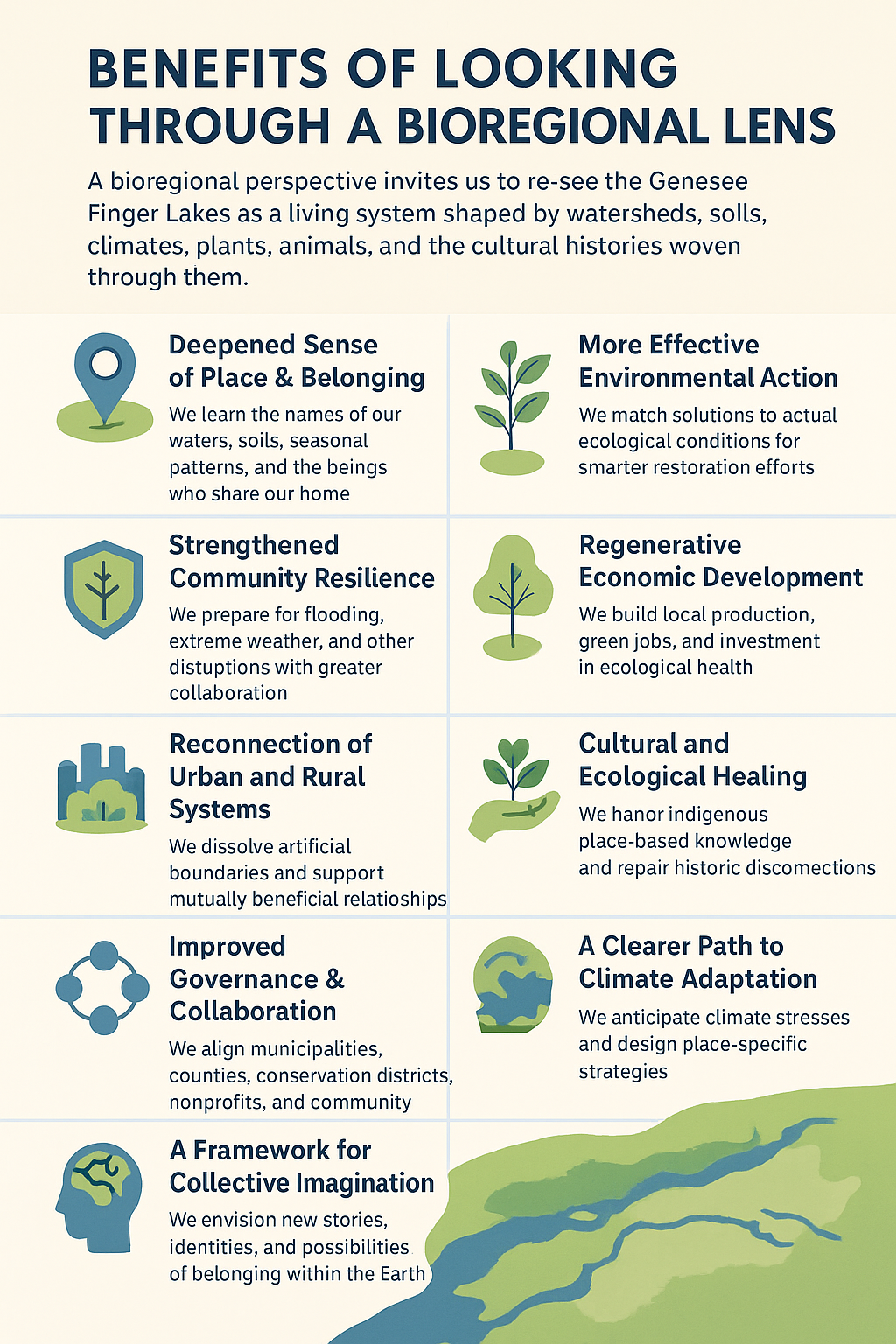
 To look through a bioregional lens is to shift our orientation from political borders and abstract metrics to the living systems that actually sustain our lives. It means noticing the shape of our watershed, the movement of local winds and wildlife, the soils beneath our feet, and the cultural stories woven through the land. This shift in perception does more than expand ecological awareness—it reshapes how we understand ourselves, how we relate to others, and how we imagine the future. When we begin to see the world bioregionally, a series of profound benefits emerges, transforming both our inner sense of belonging and our collective capacity to act wisely.
The first gift of a bioregional lens is a deepened sense of place and belonging. By learning the names of our rivers, soils, native species, and seasonal patterns, we cultivate a rootedness often absent in modern life. This connection creates a foundation for caring—caring for the land, for our communities, and for future generations. Closely linked to this is the ability to take more effective environmental action. Every region has its own climate pressures, ecological thresholds, and opportunities for regeneration. Strategies that work in the Southwest may fail in the Great Lakes. A bioregional approach ensures that solutions are tailored, grounded, and aligned with the specific ecological realities of place.
This place-based understanding also strengthens community resilience. Bioregions define natural units for resilience planning—watersheds, foodsheds, microclimates. Organizing around these boundaries enables communities to respond to climate disruptions with confidence and coordination. And because healthy ecosystems underpin healthy economies, a bioregional lens guides us toward regenerative economic development. When we invest in local production, renewable energy, ecological restoration, and circular resource flows, we create livelihood systems that heal rather than harm.
A bioregional view also bridges the often artificial divide between urban and rural worlds. Cities rely on nearby rural landscapes for water, food, biodiversity, and climate moderation; rural communities rely on urban markets, infrastructure, and culture. Seeing these systems as interdependent opens the way for urban–rural reconnection, replacing tension with collaboration and mutual benefit.
Beyond policy and infrastructure, bioregionalism supports profound cultural and ecological healing. It resonates deeply with Indigenous worldviews that understand land, identity, and story as inseparable. By honoring these perspectives and learning from them, communities can rebuild reciprocal relationships with the more-than-human world. This, in turn, leads to more coherent governance—when communities collaborate at the watershed or ecosystem scale, decision-making becomes less fragmented and more aligned with natural systems.
Climate adaptation is another domain where bioregional thinking shines. Because climate impacts manifest regionally—through changes in rainfall, flooding patterns, species distribution—bioregional awareness provides a clearer path to adaptation, enabling communities to anticipate risks and design strategies rooted in real conditions. At the same time, bioregionalism expands our collective horizon of possibility. It offers a framework for imagination, helping communities envision futures where human activity regenerates rather than diminishes the Earth.
Looking through a bioregional lens also strengthens regional food systems, reconnecting people to the farms, forests, fisheries, and soils that nourish them. This awareness naturally leads to enhanced water literacy, as people begin to understand their watershed from ridge to river to lake. With this comes clearer stewardship of rivers, streams, wetlands, and aquifers.
A bioregional approach is equally critical for biodiversity conservation. Ecosystems don’t follow county lines, and species don’t stop at state borders. Restoring habitats, migration corridors, and ecological processes requires organizing at the scale of natural systems—a hallmark of bioregional thinking. This ecological grounding reinforces community identity and pride, giving people a sense of shared meaning rooted in the distinctive landscapes and cultural histories of their home region.
Education is transformed as well. When learning is rooted in local ecology, geology, and culture, it becomes more vivid, relevant, and memorable. Place-based education cultivates lifelong ecological literacy and strengthens the connection between people and their landscapes.
A bioregional lens also encourages communities to rethink what progress means. Instead of relying solely on economic indicators, bioregionalism promotes more relevant measures of well-being, including watershed health, community cohesion, biodiversity, and cultural vitality. Living within the rhythms of local systems also helps reduce ecological footprints, as people shift toward local sourcing, renewable energy, and regenerative land use practices.
This awareness strengthens social cohesion. When people recognize that they share the same watershed, foodshed, or forest corridor, they develop bonds of reciprocity and mutual care. These connections support better resource management, ensuring that soils, forests, water, and fisheries are stewarded within the ecological limits of the region.
Perhaps one of the most important outcomes of bioregional thinking is the reintegration of the human and more-than-human worlds. Instead of treating nature as a backdrop or a resource, we begin to see ourselves as participants in living systems—an understanding that cultivates humility, gratitude, and responsibility. Ultimately, all these benefits work together to form a guiding framework for regenerative transition. In a time of ecological destabilization and social fragmentation, the bioregional lens offers clarity, coherence, and direction. It invites us to rebuild our economies, communities, and cultures in alignment with the ecological realities of our home places.
To see bioregionally is to see more truthfully. It reveals connections long obscured, possibilities long ignored, and responsibilities long deferred. It shifts us from abstraction to participation, from separation to belonging, from extraction to regeneration. And in doing so, it opens the path toward a flourishing future—one that begins right where we stand.